 Walters Sentinel
We specialise in website, domain and email monitoring.
Walters Sentinel watches your websites, SSL certificates, domains, DNS and email security from outside your network, around the clock. When something fails you hear from us straight away - including when the provider that failed is the one that should have told you.
- One website monitored on the free plan
- Alerts by email, text and webhook
- Hosted in the UK and EU
Your second pair of eyes, or your first.
Whether you run your own servers or have never touched a DNS record, the same checks tell you what has gone wrong and what to do about it.
IT teams and administrators
Your hosting, email and DNS providers have their own monitoring, but if their systems are the ones that have failed, they cannot warn you. We check from outside every provider you use, so you hear about it anyway. Keep us as the independent second source your risk register asks for.
Organisations without an IT team
Practices, schools, charities and small firms rarely have somebody watching certificates, renewals and email records. We are the ones who notice the expiring certificate, the domain about to lapse or the missing DMARC record, and tell you exactly what to change, in plain English.
Websites, certificates and domains, watched around the clock.
Hear about a problem before your customers do, from a check that runs outside your own network.
Uptime and response
Your websites and APIs checked as often as every minute, from London. A failure has to repeat before anybody is alerted, so one slow answer never wakes you at 3am.
Certificates and domains
SSL certificates and domain registrations watched for expiry, with a warning two weeks before a certificate runs out and a month before a domain does, so a renewal nobody owned never takes your website or your email offline.
DNS and email records
Your DNS records and SPF, DKIM and DMARC checked for changes, and your mail servers checked against the blocklists that stop your email arriving.
Alerts that reach someone
Email, text message, Slack, Teams or any webhook, to a list of people rather than one inbox, escalating to a second list if nobody acts.
Quiet when it should be
Quiet hours in your own timezone, and maintenance windows that hold alerts during a planned change while the checks and the history carry on.
Pages behind a login
Check that a signed-in page really works, not just that the server answers. Any credentials are encrypted before they are stored and never shown again.
Stop criminals sending email that looks like it came from you.
Fake invoices and "we've changed our bank details" emails work because they look real. Mail Shield makes sure your domain cannot be used for them, and tells you the moment that changes.
Every record that matters
MX, SPF, DKIM, DMARC, MTA-STS, TLS reporting and BIMI read from your public DNS, and your mail servers checked against the blocklists.
Exactly what to change
A grade out of 100, and every fix written out as the record to paste into your DNS. No guessing what a "p=quarantine" should look like.
Who is sending as you
The DMARC reports large mail providers send are read for you, showing every server sending email as your domain and whether it passed.
Told when it changes
On a paid plan every domain is re-checked daily, and you are emailed if a record changes or disappears - often the first sign somebody has been in your DNS.
Can criminals send email as your business?
Three DNS records - SPF, DKIM and DMARC - are what stop somebody sending email as your domain, and plenty of organisations are missing at least one.
Check yours in about ten seconds. You'll get a grade and the first things to fix.
Only public DNS records and public blocklists are read. New to these records? SPF, DKIM and DMARC, explained.
Your website and your email fail together.
They share a domain, and usually a provider. A lapsed domain takes both offline, a DNS change can break both at once, and the provider you would ask is often the one having the bad day. Watching one without the other leaves half the picture.
Watch both from one account.
Add Mail Shield to Monitoring, or Monitoring to Mail Shield, whenever you are ready: one sign-in, one team, one set of alerts and one bill. Or take the two together as one subscription, for less than buying each.
From one website to every domain you run.
Monitoring has a free plan for one website. Every paid plan can be tried for 14 days, once per account, and is cancelled online in one click.
Together, and for larger organisations
Reminded before you pay
We email you before a trial ends and before a yearly renewal, with the date and the amount.
Cancel in one click
Cancel online from Billing, no calls or forms. You keep what you have paid for until the end of the period.
Nothing deleted if you stop
Your monitors, domains and their history stay where they are, ready if you come back.
Built and run in the UK
Application servers in London, the database in Ireland (EU), and everything stored encrypted. A real person answers your emails.
Certificates your customers can check for themselves
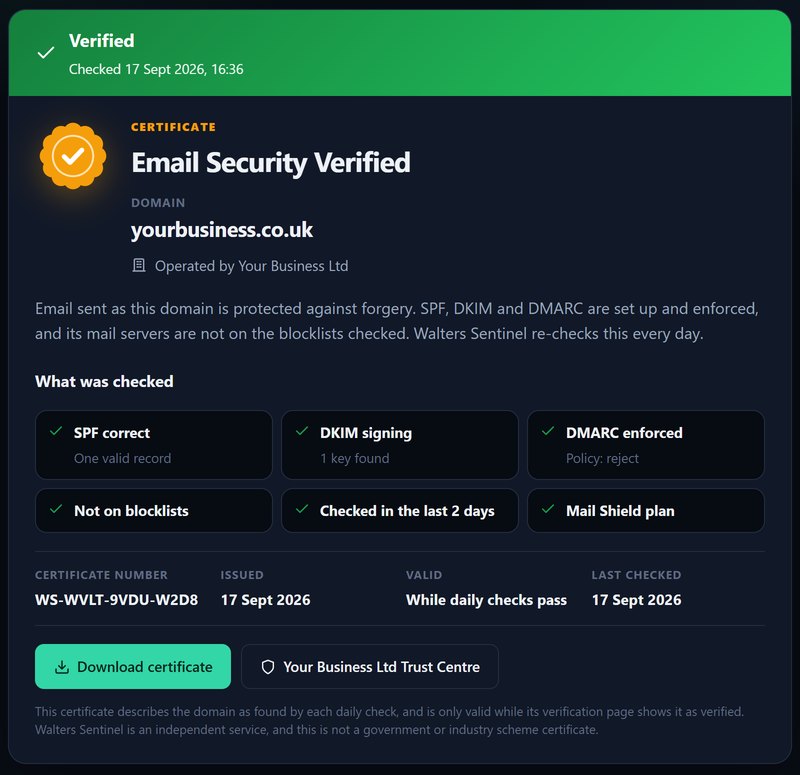
The checks we already run become certificates. Each one has its own public page, a PDF to send with proposals and tenders, and a badge for your website that updates itself every day.

Email Security Verified
Your domain has SPF, DKIM and an enforced DMARC policy, so criminals cannot send email that passes as you. Included with Mail Shield.

Uptime Verified
Your website was up at least 99.9% of the last 30 days, over valid HTTPS. Included when you pay for Monitoring.

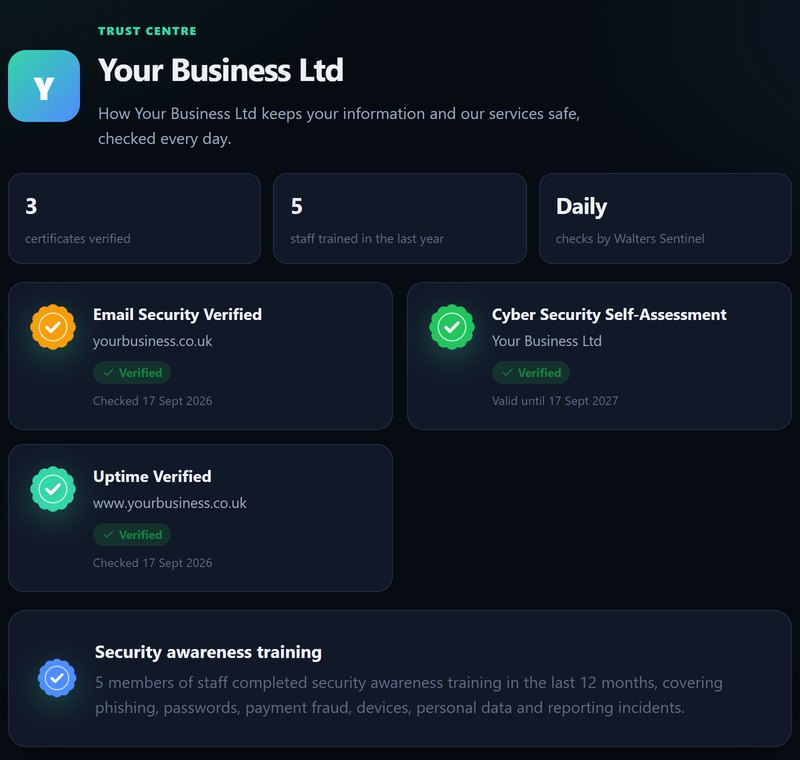
Cyber Security Self-Assessment
Every question on the five Cyber Essentials controls answered yes, and confirmed by a named director. Clearly labelled as self-assessed. Included with Comply.

Security Awareness Training
A 26-minute course on phishing, passwords, payment fraud, devices and personal data, with a certificate in each person's own name. Included with Comply.
One link that answers the security questionnaire
Publish a Trust Centre at trust.walterssentinel.com with every current certificate and your live uptime. Put it in your website footer, your proposals and your tender answers.
Watching in five minutes.
Add what matters
Your website addresses and your email domains. Nothing to install, and nothing on your servers.
Say who to tell
The people who should hear when something fails, and how: email, text, Slack, Teams or a webhook.
Get on with your day
We check around the clock, tell you the moment something fails, and tell you again when it is fixed.
Want the full website security report?
The same 25-check security and configuration audit our monitoring customers get automatically - certificates, security headers, cookies, exposed files, email authentication - for a single website. One payment. No account. Scored out of 100, with a plain-English fix for everything that's wrong.
£29 one-off, per website
Get your Website Security ReportMore, on the same account.
 Status PagesCustomers kept informed during an incident
 Access reviewsWho can get into what, checked on a schedule
 AssetsEvery device and licence, and who has it
- ComplyCyber Essentials readiness, staff training and GDPR records
 HandbookPolicies your staff have read and accepted
 RisksA risk register with owners and review dates
 IncidentsA response checklist, a timeline and the 72-hour ICO clock
- PeopleStaff records, starters and leavers
 VisitorsA private record of who is on site
 SignDocuments signed with an audit trail
 FormsRequests and declarations, with every answer encrypted
 DeskRequests tracked from arrival to answer
 BookingsAppointments, with customer details encrypted
Before you start
My hosting or email provider already monitors things. Why use you?
Because their monitoring runs on their systems. When those are what has failed - or the problem is a certificate, a renewal or a DNS record on your side of the line - they may not tell you, or not quickly. We check from outside every provider you use, so you have an independent second source of the truth. If you have no IT team at all, we are usually the first source.
How often do you check?
As often as every minute, depending on your plan. A failure has to be confirmed by repeated checks before an alert goes out, so you are told about real problems rather than one slow answer.
What if Walters Sentinel itself has a problem?
Our own status is public at monitoring.walterssentinel.com/status, and we post there as soon as we know. Our checks run from our own servers in London rather than from inside the systems we are checking, so a problem at one of your providers does not stop us checking it.
Do I need to be technical?
No. You give us addresses and domains, and every problem comes with what to do about it. Where a DNS record needs changing, we show you the exact record to copy.
Are your certificates official?
They are Walters Sentinel certificates, based on checks we run ourselves, and each says exactly what was checked. They are re-checked every day and show when they stop passing. They are not government-backed or accredited, and we never say they are.
How does the free trial work?
Each account can try a paid plan free for 14 days, once. You add a card when you start, and nothing is taken during the trial. We email you before it ends. If you cancel before then you are not charged; if you do nothing, your subscription carries on and the first payment is taken when the trial ends.
Do subscriptions renew automatically?
Yes. You pay monthly or yearly, and your subscription renews until you cancel. We remind you before yearly renewals and regularly for monthly ones, with the date and the amount. Payments are non-refundable except where the law says otherwise - see the Terms.
How do I cancel?
Open Billing in your account and choose Cancel. It takes one click, with no calls or forms, and we confirm it by email. You keep what you have paid for until the end of the period, and nothing you added is deleted.
Is it suitable for larger organisations?
Yes. Company sign-in works with your own identity provider (Okta, Microsoft Entra ID, Google Workspace and others) and can be required for everybody at your domain, and your provider can add and remove people automatically. There are passkeys, roles, an audit log of every change, a published Data Processing Agreement and sub-processor list. See Walters Sentinel for larger organisations.
Where is my data stored?
Our application servers are in London and our database is in Ireland (EU), and everything we store is encrypted. See the Privacy Policy for what we store and how long it is kept, and the sub-processor list for every supplier and where they are.
Do you store my passwords or sensitive credentials?
No. We only need the public details of what you want watched. The one exception is monitoring a page behind a login, where the credentials you choose to give are encrypted before they're stored and never shown again.
Know before your customers do.
Start with one website or one domain. For a larger rollout, company sign-in or procurement questions, talk to us.
Talk to a person
Which plan fits, monitoring a lot of websites or domains, company sign-in, a security questionnaire, or procurement paperwork: ask. A real person reads these and replies, usually within one working day.
- Your pace. We answer by email, or arrange a call or a walkthrough if you would rather talk it through.
- Ask us anything technical. DNS records, DMARC, monitoring behind a login, company sign-in.
- Already a customer? Say so and it goes to the front.
Prefer your own mail client? contact@walterssentinel.com